Photon Pulse·Product design·2025
Designed a product that turned a traditional law firm into an AI-Native IP Tech company.
- Role
- Product Designer,
0-1 - Team
- One PD, Two Devs,
One AI engineer - Timeline
- ~2.5 months
- Company
- Photon Legal
$10K → $100K
avg ACV jumped, unlocking enterprise-size global customers!
$1M
the biggest client the
product helped close
1,000+
patents managed
across 20+ clients
The context
Patents are company value. A strong portfolio raises valuation, protects products, and signals seriousness to investors, which is why companies encourages their employees to file more of them.
Photon Legal is the firm those companies hire to get patents granted.
Getting a patent filed takes three people, in this order:
- 01Inventor. Has the idea, inside the client company.
- 02In-house counsel (IHC). The client's own legal team. Judges whether the idea fits the business.
- 03Outside counsel (OC). Photon Legal. Takes it through filing and grant.
At its core, the business faced three problems:
- 01
Ideas went from the inventor to in-house counsel to Photon and back again, on email or Slack, stalling at each stop until someone had time. Photon gets paid when patents get filed, so ideas sitting still meant business sitting still.
- 02
Inventors filled long forms with no clear incentive, so they filed less, and fewer filings meant less value for clients and less business for Photon.
- 03
All the data lived in Excel sheets, so checking a patent's status, a client's next steps, or the state of the whole business all meant hunting through it or asking whoever managed it.
Understanding the business
Talked to the Photon team
How work flows inside the firm, how they deal with clients and inventors, and what counts as a win for the business.
Researched the industry
Why companies file patents at all, what a granted one is worth to them, and who else was already selling into this market.
Mapped where an idea breaks
Sketched how an idea travels across the three roles today, then ranked each broken step by what fixing it would do for the business.
Working it out
Then I started sketching the flows. The communication between the three roles took the most work: who sees what, who waits for whom, and what each role can do at each step.
The product engineer and I drew every state of that communication on a whiteboard. It took plenty of sessions and brainstorming to work through every case.
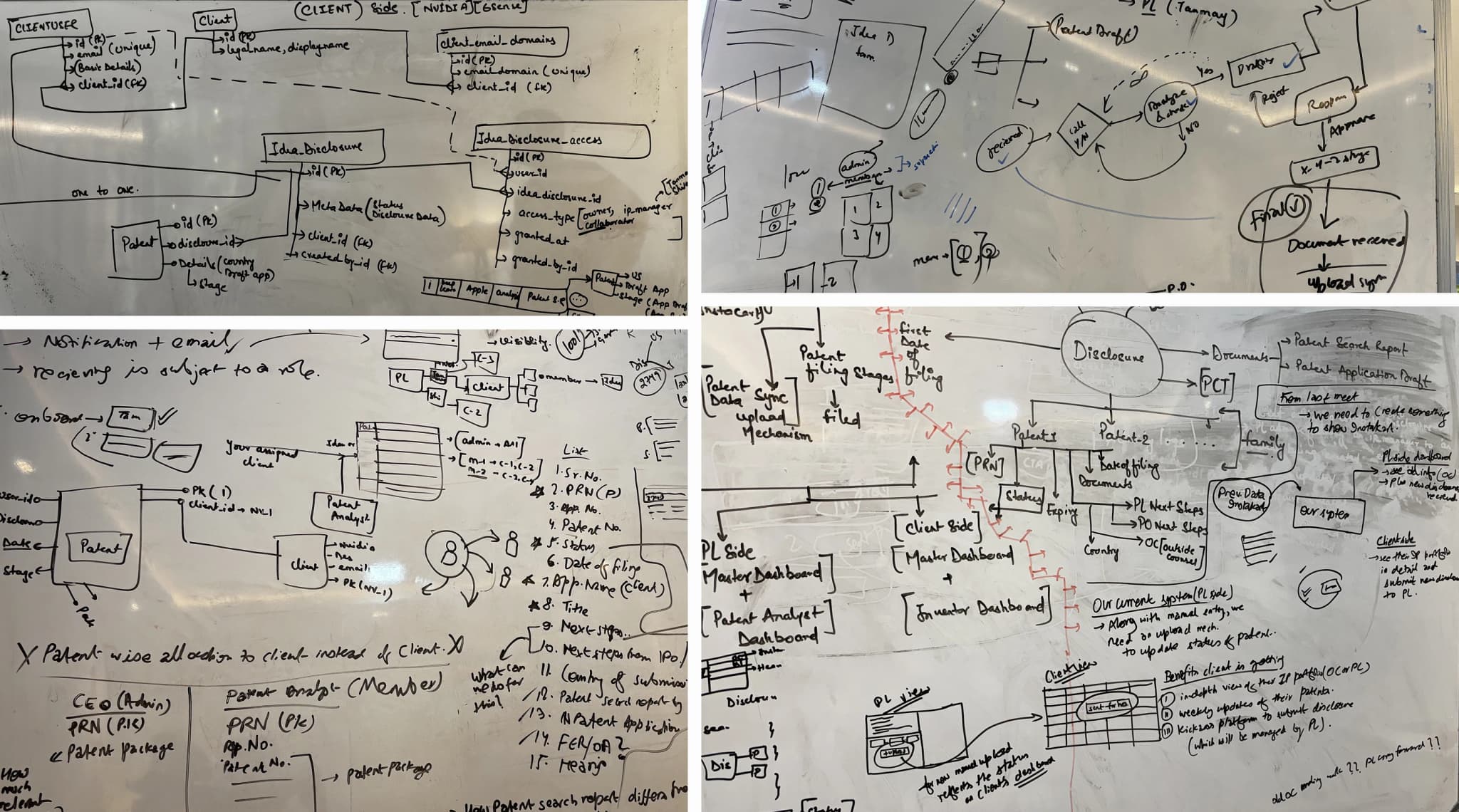
Then I wireframed the solutions and walked them through with Photon's team, so we agreed on what each one had to do for the business.
Introducing Photon Pulse
Photon Pulse is an AI-native patent management platform for everyone involved in getting a patent filed.
- In daily use by inventors, in-house counsel, and the firm.
- The product itself became the firm's strongest sales asset.
The Solutions
Problem
Filing started with a long form full of generic questions. Writing patents is not an inventor's job, so they had nothing to aim at. What came back mostly was thin, or long and still missing the point.
CHALLENGE
The proposal was a voice-first intake: one button, the inventor speaks the whole idea, AI scores the recording. The instinct behind it made sense, take the effort out for someone who has no reason to spend it. But something about it did not click for me, so I asked for a few days before agreeing.
RESEARCH
I talked to a few inventors. An idea is months of work, and no one can recall all of it in one go. And the bigger thing they told me: they did not know what exactly to say for anyone to judge whether the idea was worth patenting. Voice on its own would have made that worse.
So I asked the patent scientists what they need to start their research. They came back with a list of 10 specific questions across 5 categories.
The agent does what they used to do, so it needs what they used to need.
WHY IT MATTERS?
A patent scientist can work with a vague answer. They ask a follow-up, or fill the gap with judgment. An AI agent cannot. Feed it something thin and it returns a bad score, which is worse than no score, because the inventor stops trusting the product on their first try.
So the input had to be good every time, not most of the time. Specific questions leave much less room for a vague answer.
SOLUTION
Three ways to give inputs now, whichever suits the inventor:
- Type into each field manually.
- Speak inside a single question, and AI writes the answer to fit it.
- Upload the messy documents you already have, and AI fills the answers for you to check.
All three end up at the same structured answers. That was the point. The quality of what the agent receives decides the quality of what it returns, and everything downstream, the score, the report, what counsel has to verify, depends on it.
02Putting the AI at the point of entry
Most products add AI at the end, to tidy up work that is already done.
Here it works at the front, the moment something enters the product, so everything after starts with quality information. Photon's problems started at the entry, so we put it there.
Problem
An inventor had no way to know if an idea was worth sending. They submitted, waited weeks for counsel, revised, and waited again.
SOLUTION
On submit, an agent runs the prior-art search across the same sources the firm's scientists used, and comes back in minutes with a score and a report. The score tells you where you stand. The report tells you why.
DESIGNING FOR TRUST
The report shows what is strong, what already exists, where to improve, and how well the idea fits the company's business goals. That helped an inventor to move toward high idea score.
AI works on probability, and filing a patent is expensive, so a score on its own was never going to be enough. Every point in the report links to the source it came from. If someone disagrees, they can read the source and check it. Patent scientists and outside counsel use the same links to verify the report before acting on it.
IMPACT
- 01Inventor. Runs three or four rounds on their own, in minutes instead of weeks, and can see exactly what the gaps are and how to fix them instead of guessing.
- 02In-house counsel. Reads the report that comes attached to the idea, which already shows how well it fits the company's business goals. No working through the whole submission to figure that out.
- 03Outside counsel. Gets an idea that already has a score and a full report behind it, with the prior-art search and similarity analysis done. They verify it and get straight to their own work.
Problem
Getting a client's portfolio into the product was the hardest part of onboarding. Everyone kept theirs in Excel with their own columns, and portfolios pulled from internet matched nothing either. It all got moved across by hand.
It delayed sales.
SOLUTION
With the team, I defined one schema and put an AI layer in front of it. Upload any sheet and it lands in the right place, with patents, ideas, and events traceable both ways. A prospect's portfolio is now ready in minutes.
Problem
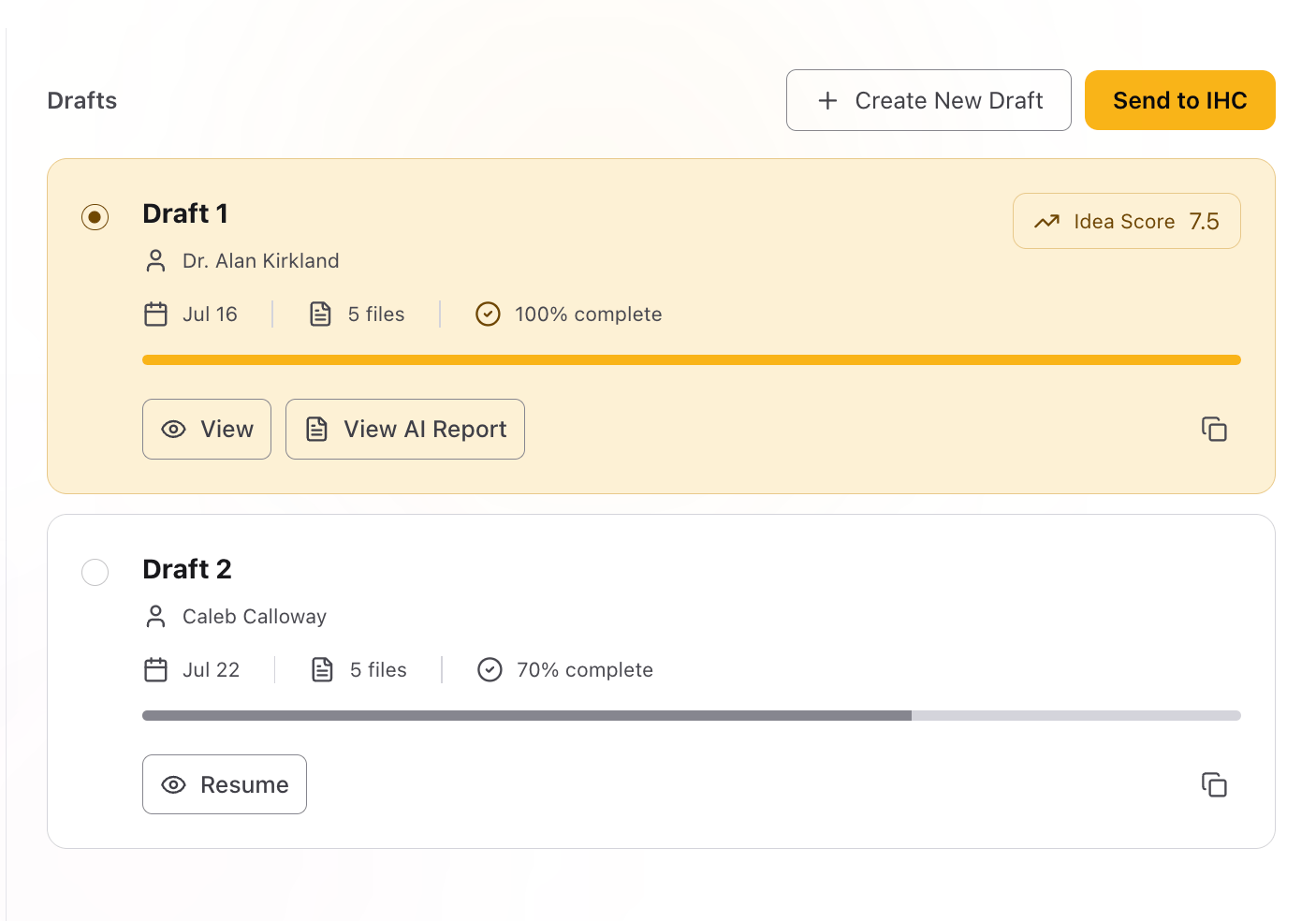
Inventors needed to send their best work forward, not their first attempt. Every weak idea that got through cost the firm and in-house counsel real time.
SOLUTION
I designed an idea to hold multiple drafts, each scored on its own, so an inventor can experiment freely and send forward the one they are happiest with.
CHALLENGES
The feedback was to drop it and keep one editable draft. Same outcome, one less click.
DESIGN DECISION
I held my ground. An inventor sitting on an 8 out of 10 will not touch that draft. AI is not deterministic, so the next run might come back a 6, and their good version is gone. So they stop experimenting and send something short of their best, which is exactly the work that eats counsel's time later.
The team saw it, and we moved ahead with my solution.
Problem
In any organization, mostly In-house counsel decides which ideas are worth spending money on, and when. If an inventor could send straight to outside counsel, the client's own legal team loses that call, and the firm starts an unapproved work.
SOLUTION
Everything an inventor sends goes to in-house counsel first. They check it and pass on what matters, and nothing reaches outside counsel any other way.
It is a small rule, but it protects the client relationship. In-house counsel decides what goes out of the company.
Problem
Most of the people using this had spent years in spreadsheets. Inventors, in-house counsel at large companies, patent scientists and lawyers. Asking them to learn new software was the fastest way to lose them, and we had a sales window with little to no room to experiment here.
SOLUTION
Open Photon Pulse and it feels familiar on purpose. Tables, lists, an AI assistant, laid out like the tools they already use.
Nothing here is new for the sake of new. Anything unfamiliar would have slowed down adoption, and someone with thirty years in spreadsheets should feel at home on day one.
Problem
Nobody could see the whole picture, at any level. Patent lawyers had to dig through a spreadsheet to find out what was due and how urgent it was, and missing a date costs real money. Founders had no fast way to get read on the business.
SOLUTION
The product gives both a bird's eye view and an ant's eye view.
- On the ground, a lawyer sees what is due and what to do first, so nothing important comes as a surprise.
- At the top, founders see how the year is going, the top clients, and which inventors contribute most, which is what they used to decide where to focus and when to hire.
Key moments
Photon was going after big names and high-ticket contracts, so the sales meeting had to land.
- Add a prospect as a potential client and feed in their data.
- The whole product fills up with their own portfolio.
- The team walks into the meeting with a working version of Photon Pulse, already loaded with the prospect's patents.
- The prospect is not imagining the product any more. They are looking at their own company inside it.
It became the centerpiece of every pitch and helped Photon close the high-ticket clients they were going after.
The first version was deliberately unpolished, and that was my call. Photon wanted to experiment first, and polishing an experiment is money spent too early. Once they started pitching high-ticket clients, that changed. If you are asking for $1M, the product has to look like it.
They were in pitches almost every other week, so I committed to around a week and used AI to move that fast.
- Two days exploring, until I found a direction that held up.
- Then redesigned the product end to end, documenting style decisions as I went.
- So the style guide grew alongside the product rather than after it.
- Then checked the whole product again: everything follows the guide, every color pair passes WCAG 2.1 AA contrast.
A full design system would have been the wrong thing to build. The product was still changing shape, and a system built for scale before there is any scale gets thrown away. No tokens, no architecture. Just enough structure to hold the product together and keep the next person on brand.
What I'd change now
- 01Talk to the inventors sooner. I spent my early time with the Photon team, since that is where the business knowledge sat. I only sat with inventors later, when the voice-first idea came up. That conversation changed the most important part of the product, so it should have happened at the start.
- 02Set the style rules on day one. The first version ended up inconsistent, and I only fixed it properly during the revamp, when I built the style guide as I went. A basic set of rules early would have saved a lot of that work.
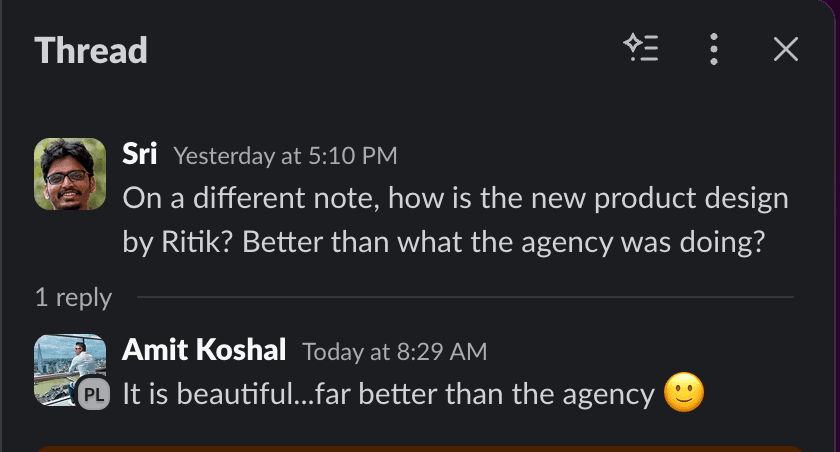
- 03Keep the work I designed. The revamp went to an agency while I was busy elsewhere, and it came back needing another look. It is hard to hand over something when most of the thinking behind it is in your own head. Next time I would either write a much clearer brief or do it myself.
Credits
- Amit and the Photon Legal team gave the access, feedback, and trust that made the product real.
- Sri and Prateek at Shifu Ventures trusted me with the project and the decisions, and gave me the resources and guidance to see it through.